
 PETERBOROUGH, ON (December 8, 2022) – The holiday season can be anything but a holiday for some local families, whose children face extra challenges dealing with the hustle and bustle of the season.
Ashley Parsons knows this all too well in her role as an Occupational Therapist at Five Counties Children’s Centre. “Whether celebrating Christmas, Hanukkah, Kwanzaa or Winter Solstice, the holiday season comes with high expectations, changes in routine and extra stimulation that can be overwhelming for some kids,” she notes. “As parents and families, it’s important to reduce the stress and anxiety created by the holidays to make it a more enjoyable time for everyone.”
According to Five Counties staff, it’s not just children on the autism spectrum or with sensory processing issues who are impacted by the holidays. “The pandemic has disrupted large gatherings and in-person celebrations, creating a situation where many kids aren’t equipped or don’t know how to socialize or engage in play with others outside their immediate families,” Parsons adds.
 Preparation is one of the best ways to gear up for the holidays, as it can help children understand and adapt to what is planned over the festive season. “If you plan to go out of town to visit family for holiday dinner, let your kids know in advance where you’re going and who you’ll see so they know exactly what to expect,” Parsons advises.
Preparing can be done in many ways, she adds. Calendars can be used to mark events and count down the days with kids. Photos, maps or videos can be good visuals to share with younger family members or children who have communication challenges, helping prepare them for who and where you’re visiting. Creating a “social story” is also very beneficial for many kids, as it helps them learn ways to respond or interact in social settings. “Social stories are great tools for giving details about a setting or visit, what happens there, and what actions or behaviour are expected from a child,” Parsons notes. “To be beneficial, social stories should be specific to the child and use simple, encouraging words to answer the where, when, who, what, how, and why of the situation.”
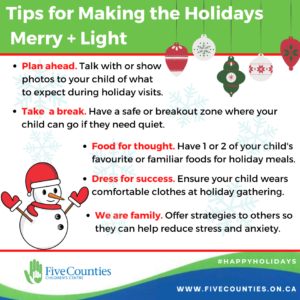
Making the holidays merry and less stressful can also involve the following:
- Decorate less or do it gradually. While holiday decorations make the season brighter, they can also be disruptive for some kids. Pulling out pictures from previous holiday seasons can help children adjust to what’s planned (if you don’t have photos, take some this year). Having kids involved in decorating can ease the process, as can taking a step-by-step approach to decorating. For instance, set up the tree one day, but wait until the next day before starting to decorate. Once decorations are up, set clear rules about what can and can’t be touched.
- Give gifts the right way. Most children get excited over holiday gifts, but for some kids, it can be overwhelming. If a child starts to obsess over a desired gift, find ways to manage their interest. For example, try a ‘five-for-five swap.’ Give your child five stickers that can be exchanged for being able to talk about the gift for a five-minute interval. To help manage holiday gift expectations, make a list with your child of realistic items he or she wants for the holidays. This list can then be shared with family members and friends who can register to purchase one of the desired gifts.
- Change for the better isn’t always better. Many children thrive on routine, and the holidays can throw off schedules. Having familiar items on hand can help calm stressful situations. If you are travelling for the holidays, make sure you have a child’s favourite books, toys, games and activities. Rehearse in advance what will happen or what can be expected to also ease children through any change or disruption of routine.
- Here’s food for thought. Enjoying a holiday meal with friends or family may not be enjoyable for all kids, especially if they are picky eaters or unlikely to enjoy unfamiliar food that’s on the menu. Some kids may also have allergies or require special diets. Have some of your child’s favourite or familiar foods on hand for dinner, either by bringing it yourself or ensuring some will be served during the holiday meal. If needed, identify a quiet area where your child can go to eat on their own if mealtime with others is too much.
- Take a break. Have a plan in case holiday visits or festivities become too overwhelming. Develop a signal that you child can use to say they need a break or want to be on their own. Work with your host to find a pre-determined quiet space for your child to de-stress. Have headphones with songs or stories that your child can wear to calm themselves and drown out surrounding noises.
- Dress for success. Ensure your child wears clothing that is familiar and will not cause discomfort if going to a special holiday dinner or event.
- Prepare others for what to expect. The holidays are a time to gather with loved ones, so help them to understand your child. Be open and honest. Offer strategies on how they can help reduce anxiety or stress with your child. Help them see that your child may prefer not to be hugged. Share potential triggers that could cause your child to become upset. Stress to loved ones the importance of remaining calm and neutral to avoid outbursts.
Parsons’ final point is this: recycling isn’t only good for the environment; it can also be good for kids over the holidays. “You know your child best, so look to what has worked for your family in situations or holidays past,” she says. “With a bit of planning and preparation, you and your child can enjoy a wonderful holiday season that is merry and a bit light!”
Category: General News